
A recent study conducted by Changbo Wang et al. has been published in Ecological Economics. This research examines the impacts of both domestic and international trade on biodiversity across different provinces in China, revealing key regions, sectors, and industrial pathways that influence biodiversity from different perspectives. The work was completed collaboratively by Wang Changbo’s research team, which includes five graduate students from the College of Economics and Management at Nanjing University of Aeronautics and Astronautics, as well as researchers from institutions such as Beijing Normal University and the University of Nottingham Ningbo China.
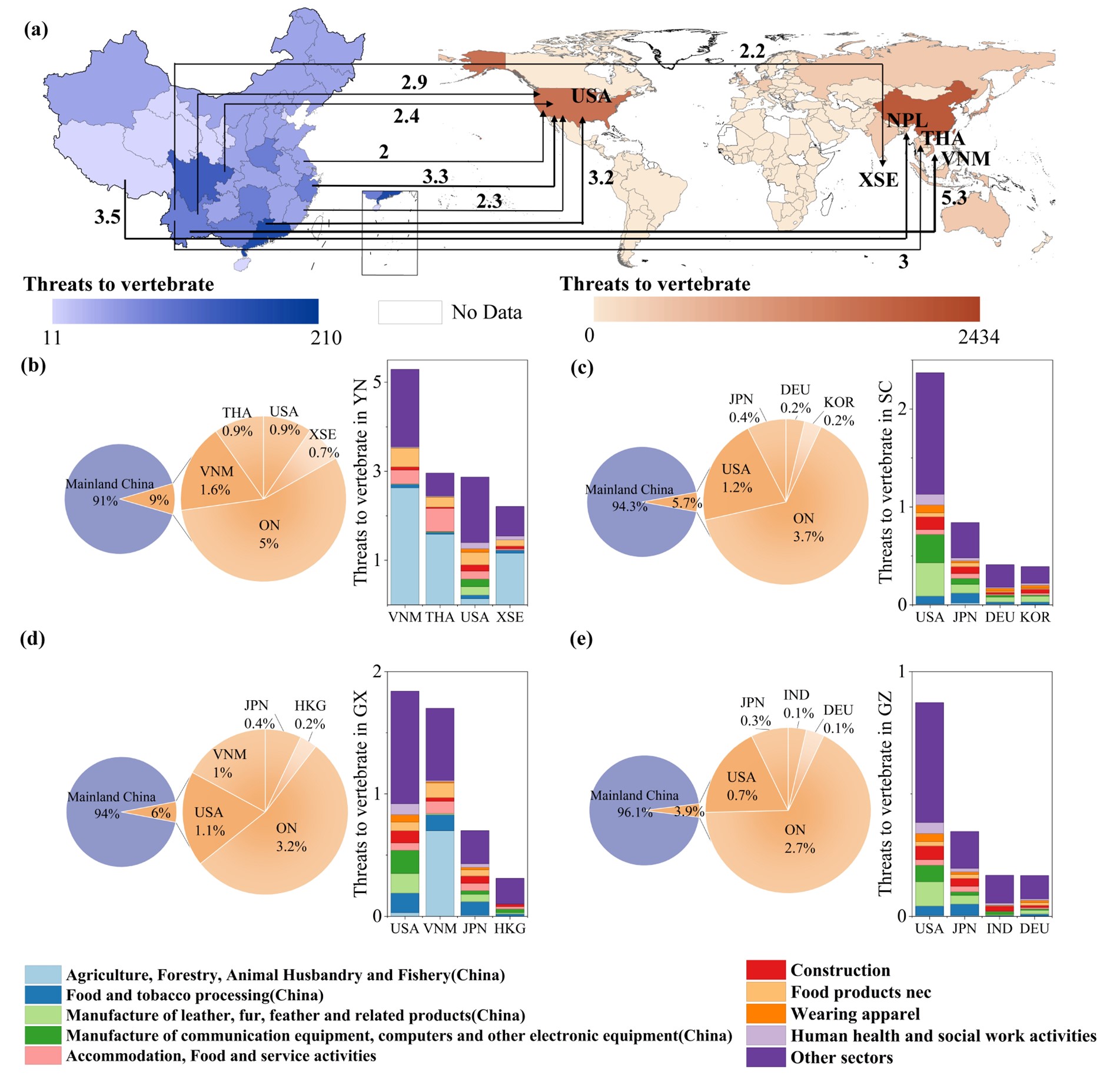
China is experiencing escalating threats to biodiversity, exacerbated primarily by economic activities, which are increasingly intensified by international and interprovincial trade. This study develops a nested multi-regional input-output model that integrates both international and subnational economic transactions, alongside human-induced pressures to investigate supply-chain drivers of anthropogenic threats to vertebrate species in China. These threats are examined from the perspectives of production, final demand, and trade linkages. The results indicate that, nationally in 2017, production activities directly threatened 794 vertebrate species listed on the IUCN Red List, corresponding to 2,665 province-species threat records. From the demand perspective, domestic consumption was responsible for the majority of species impacts (91%), with Yunnan, Sichuan, and Guangxi provinces emerging as key regional contributors. In contrast, economically large or densely populated provinces, such as Guangdong and Henan, primarily experienced biodiversity pressures due to demand from other regions. At the international level, consumption of Chinese agricultural, leather, and electronic equipment products in the United States, Japan, and Viet Nam contributed substantially to vertebrate threats within China. Scenario analyses further indicate that interprovincial trade exerts a stronger influence on biodiversity threats than international trade. Together, these findings highlight critical nodes within domestic and global supply chains that disproportionately drive vertebrate declines, underscoring the necessity for coordinated, multi-faceted policy interventions to effectively mitigate biodiversity loss in China.
Ecological Economics, an internationally authoritative journal in ecological economics, is one of the top five journals in the field of resources and environment. It is ranked as ABS 3, SSCI-Q1 and FMS B. The journal aims to publish high-quality research on the relationship between ecosystems and human activities.
This paper can be cited as:
Wang C B, Wang W D, Yan X L, et al. Impacts of international and interprovincial trade on red list species of vertebrate in China. Ecological Economics, 2026, 247, 109048.
A complete version of this paper can be accessed via:
https://www.sciencedirect.com/science/article/pii/S0921800926001333?dgcid=author

Nanjing University of Aeronautics and Astronautics
Copyright 2017 | All Rights Reserved with NUAA